Best Healthcare AI Receptionist Solutions for 2026

What are the best AI receptionist options for healthcare today?
The leading healthcare AI receptionist platforms in 2026 are OmniMD, MedReception.ai, DeepCura, Simbie AI, Hyro, Luma Health (ARIA), Retell AI, Emitrr, and Klara. Each one answers patient calls around the clock, connects to your EHR, and handles the front desk tasks that eat up your staff’s day. The difference between them comes down to how deeply they integrate, what they automate beyond scheduling, and how well they handle the edge cases your team currently dreads.
Here is what the best platforms deliver as a baseline:
- 24/7 call answering with instant patient pickup in 1–2 seconds, no hold music, no IVR menus
- EHR integration via FHIR R4 APIs with systems like Epic, Athenahealth, Cerner, and eClinicalWorks
- Appointment scheduling and rescheduling that honors provider availability, visit types, and insurance plans in real time
- Insurance verification against live payer data before the appointment is confirmed
- Patient intake automation collecting demographics, consent forms, and history before the visit
- HIPAA compliance with signed Business Associate Agreements (BAAs) and encrypted data handling
- Escalation protocols that route clinical questions and urgent calls to human staff immediately
- Multi-language support covering diverse patient populations without extra staffing
The right platform for your practice depends on your EHR, your call volume, and whether you need capabilities like billing follow-up, triage routing, or SMS fallback. The comparison below breaks that down directly.
How do the top AI receptionist platforms for clinics compare?
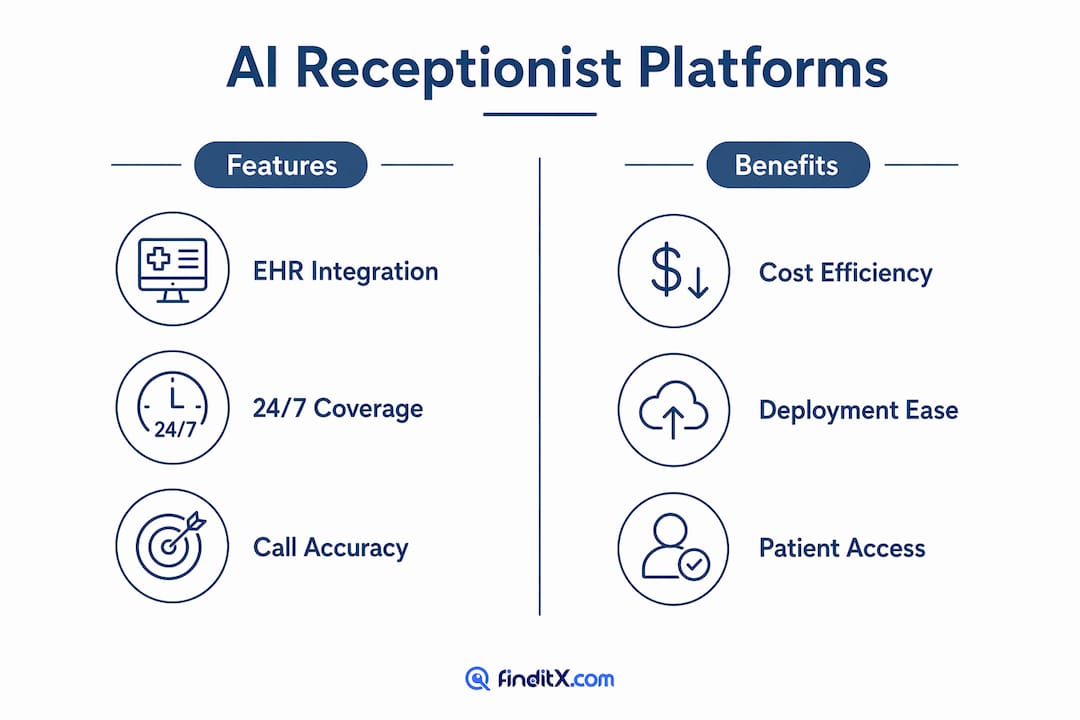
Every platform in this category claims 24/7 availability and EHR integration. The real differences show up in deployment speed, what happens when a call gets complicated, and which administrative tasks the AI actually handles end to end.
| Platform | Key Features | EHR Integration | 24/7 Coverage | Accuracy & Speed | Cost Benefit | Deployment Ease | Best For |
|---|---|---|---|---|---|---|---|
| OmniMD | Full front desk automation, insurance verification, multi-language | Deep native EHR integration | Yes | High; real-time insurance checks | Replaces multiple FTE roles | Moderate | Practices needing deep EHR integration |
| MedReception.ai | 24/7 call answering, dynamic scheduling, customizable rules | Solid EHR connectivity | Yes | Fast call resolution | Cost-effective for small clinics | Quick setup | Small to mid-sized clinics |
| DeepCura | AI call handling plus live SMS fallback | EHR-connected | Yes | High accuracy with SMS backup | Reduces missed follow-ups | Moderate | Practices needing SMS fallback |
| Simbie AI | Appointment scheduling, patient intake, HIPAA-compliant | EHR scheduling integration | Yes | Reliable intake capture | Reduces intake admin costs | Straightforward | Intake-focused practices |
| Hyro | Conversational AI, triage routing, escalation protocols | Healthcare system APIs | Yes | Reasoning-based, fast escalation | Reduces triage staff load | Moderate | Providers needing AI triage |
| Luma Health (ARIA) | Multichannel reminders, patient engagement, AI call handling | Tight practice management integration | Yes | Consistent across channels | Reduces no-shows and admin | Moderate | Integrated patient engagement |
| Retell AI | Multimodal AI, appointment management, cross-channel comms | Multi-channel EHR support | Yes | Fast across channels | Reduces communication overhead | Flexible | Multi-channel communication needs |
| Emitrr | Scheduling, reminders, billing support, automated outreach | EHR and billing system integration | Yes | Reliable for billing queries | Cuts billing follow-up costs | Easy | Clinics with billing automation needs |
| Klara | Patient messaging, scheduling, EHR updates | Seamless EHR sync | Yes | Strong messaging accuracy | Reduces phone volume | Easy | Patient-centric messaging practices |
OmniMD stands out for practices that need the most complete front desk replacement. Its native EHR connections handle real-time insurance verification and multi-language calls without requiring middleware. For a busy multi-provider group practice, that depth matters more than a fast setup time.
MedReception.ai takes the opposite approach: get live fast, handle calls well, and let your team configure scheduling rules without a long IT project. Solo practices and small group clinics get real coverage within days rather than weeks.
DeepCura solves a specific problem that most platforms ignore. When a patient call gets complex and the AI cannot resolve it cleanly, DeepCura triggers a live SMS thread so the conversation continues without the patient having to call back. That fallback capability is genuinely uncommon.
Simbie AI focuses tightly on intake. If your bottleneck is the time staff spend collecting demographics and consent forms before visits, Simbie’s automated intake capture pushes that data directly into your EHR before the patient arrives.
Hyro goes further than reception. Its reasoning-based voice agents handle triage routing with escalation protocols you define, making it the right fit for urgent care centers or specialty practices where the line between scheduling and clinical triage is thin.
Luma Health (ARIA) wraps AI call handling inside a broader patient engagement platform. Multichannel appointment reminders, recall campaigns, and two-way messaging all live in the same system, which reduces the number of tools your staff manages.
Retell AI covers multimodal communication: phone, SMS, and web chat from a single AI layer. Practices with patients who prefer texting over calling will find this flexibility useful.
Emitrr adds billing query handling to the standard call and messaging automation stack. Patients can ask about balances, payment plans, and billing status without reaching a human, which reduces inbound billing calls significantly.
Klara centers everything on the patient messaging experience. Its AI updates the EHR automatically when patients respond, keeping records current without staff manually entering data.
How does an AI medical receptionist actually work?
The core technology is a reasoning-based voice agent powered by a large language model, not a scripted phone tree. When a patient calls, the AI interprets their intent from natural speech, asks follow-up questions when needed, and acts on the answer by pulling or updating records in your EHR. No button presses. No menu navigation.
Call answering happens within 1–2 seconds. The AI identifies whether the caller wants to schedule, reschedule, request a refill, check insurance, or ask a general question. It then pulls the patient record, verifies insurance eligibility against live payer data, checks provider availability, and confirms the appointment directly in your EHR. A confirmation goes out by SMS or patient portal. A reminder follows 24 hours before the visit. If the patient does not show, the AI reaches out automatically with the next available opening.

EHR integration runs through FHIR R4 APIs with SMART on FHIR and OAuth 2.0 scoped access, meaning the AI requests only the minimum data permissions each interaction requires. Compatible systems include Epic, Cerner, Athenahealth, and eClinicalWorks. Insurance verification uses X12 EDI 270/271 transactions for real-time eligibility checks.
The workflow for a standard scheduling call looks like this:
- Patient calls; AI answers within 1–2 seconds
- AI identifies caller intent through natural conversation
- Patient record retrieved or created in EHR
- Insurance eligibility verified in real time
- Provider availability checked against scheduling rules
- Appointment confirmed and written to EHR
- SMS or portal confirmation sent to patient
- Automated reminder sent 24 hours before visit
- Pre-visit intake forms collected and pushed to EHR
Escalation is built in, not bolted on. Clinical questions and symptom triage above defined thresholds route immediately to your staff queue with full call context. The AI never attempts to answer clinical questions. Billing disputes and any patient request for a human transfer the same way.
What real benefits do clinics see from AI reception?
A significant portion of scheduling calls resolve without any human involvement when an AI medical receptionist handles the front desk. That is not a marginal efficiency gain. It means your staff spends the majority of their day on work that actually requires human judgment, not answering the same five questions about office hours and insurance.
Up to 70% of scheduling calls can be resolved by AI without human intervention, freeing your front desk staff for complex patient needs and reducing operational costs across the practice.
The operational benefits break into three categories:
Staff burnout reduction. Reception is consistently one of the highest-turnover roles in a medical practice. Removing the repetitive call volume from your team’s day changes the job entirely. Staff handle escalations, complex patient needs, and in-person interactions instead of fielding the same scheduling calls on repeat.
Patient access improvement. Most practices route after-hours calls to voicemail. An AI receptionist picks up at 2 AM and books the appointment. Patients who call during lunch, evenings, or weekends get the same experience as a mid-morning call. That availability directly increases appointment bookings without adding staff hours.
Cost savings. AI receptionists are priced per provider seat and call volume tier, typically replacing 1–3 full-time receptionist roles per practice. The cost model scales with your practice rather than requiring a fixed headcount regardless of call volume.
Additional benefits practices report:
- Fewer scheduling errors because the AI checks provider rules in real time
- Reduced no-show rates through automated reminders and outreach
- Faster patient intake because forms are collected before the visit
- Consistent call handling quality regardless of time of day or staff availability
- Multi-language coverage for diverse patient populations without hiring bilingual staff
How do you choose the right AI receptionist for your practice?
Start with your EHR. If your practice runs on Epic or Cerner, confirm that the vendor integrates natively via FHIR R4, not through a third-party middleware layer that adds latency and a second compliance surface. OmniMD and platforms built around FHIR R4 with SMART on FHIR access are the safer choice for practices where EHR data accuracy is non-negotiable.
Key evaluation criteria to prioritize:
- HIPAA compliance depth: Does the vendor sign a BAA before any PHI is exchanged? Is data encrypted with AES-256 at rest and TLS in transit? Ask specifically whether PHI is excluded from model training.
- Escalation protocol control: Can you define exactly which call types route to staff, and does the AI hand off with full call context?
- EHR integration scope: Does it write back to your EHR in real time, or does it queue updates for manual review?
- Deployment timeline: A typical implementation runs 2–4 weeks from signed BAA to first live call. Vendors promising same-day deployment without a testing phase are skipping steps that matter.
- Language coverage: If your patient population includes non-English speakers, confirm which languages the AI handles natively versus through real-time translation.
- Pricing structure: Most vendors charge per provider seat and call volume tier. Get a clear number for your specific call volume and EHR integration scope before signing.
Questions to ask every vendor before you commit:
- Will you sign a BAA before we share any PHI?
- Is patient data used to train your AI models?
- What is your SOC 2 Type II certification status?
- How do escalation rules work, and who controls them?
- What is the audit trail retention period for call logs?
- What happens if your system goes down during business hours?
Pro Tip: Ask the vendor to walk you through a live escalation scenario before you sign. A vendor who cannot demonstrate exactly how a clinical question routes to your staff in real time has not built that capability as carefully as their marketing suggests.
Pricing models vary, but the total cost of ownership calculation is straightforward: compare the vendor’s annual cost against the fully loaded cost of the receptionist roles it replaces, factoring in benefits, turnover, and training. For most practices, the math favors AI at moderate call volumes.
What advanced capabilities separate the best platforms?
The gap between a basic AI phone system and a true virtual healthcare assistant comes down to how the AI reasons, not just what it can do. Rule-based IVR systems follow scripts. Reasoning-based voice agents powered by large language models interpret caller intent, handle unstructured requests, and adapt mid-conversation when a patient changes what they need. That difference shows up in call completion rates and patient satisfaction scores.
Advanced features that distinguish leading platforms:
- Reasoning-based intent detection that handles natural, unscripted patient speech without forcing callers into menu paths
- Live SMS fallback during calls when resolution requires a follow-up thread (DeepCura’s standout capability)
- Real-time insurance eligibility via X12 EDI 270/271 with prior authorization status and patient responsibility estimates
- Medical vocabulary tuning so the AI correctly handles drug names, procedure codes, and specialty-specific terminology
- Multi-language support covering 80+ languages via real-time translation, with native fluency in languages like French, Portuguese, and German
- Tamper-evident audit trails with 7-year retention for HIPAA regulatory compliance
- Automated patient re-engagement that reaches out to no-shows and lapsed patients without staff involvement
On compliance, “HIPAA-compliant” in a vendor’s marketing materials is not the same as verified compliance. Best practice requires confirming that the vendor signs a BAA specifically covering AI call data, that PHI is excluded from model training, and that audit logs are tamper-evident with long-term retention. AES-256 encryption at rest and TLS in transit are the floor, not the ceiling.
Pro Tip: Request the vendor’s most recent SOC 2 Type II audit report, not just a self-attestation. A completed audit report shows that an independent auditor reviewed the actual controls, not just the vendor’s claims about them.
The practices that get the most from AI reception are the ones that treat deployment as a workflow redesign, not a technology swap. Configure escalation rules to match your clinical protocols, set up intake forms to collect exactly what your EHR needs, and brief your staff on what the AI handles so they can focus on what it does not.
Finditx handles the calls your front desk keeps missing
The platforms compared above are purpose-built for large healthcare systems and multi-provider group practices. They are powerful, and they come with enterprise implementation timelines and pricing to match. If you run a smaller practice or a clinic where the front desk bottleneck is missed calls and unbooked appointments rather than complex EHR orchestration, there is a faster path.
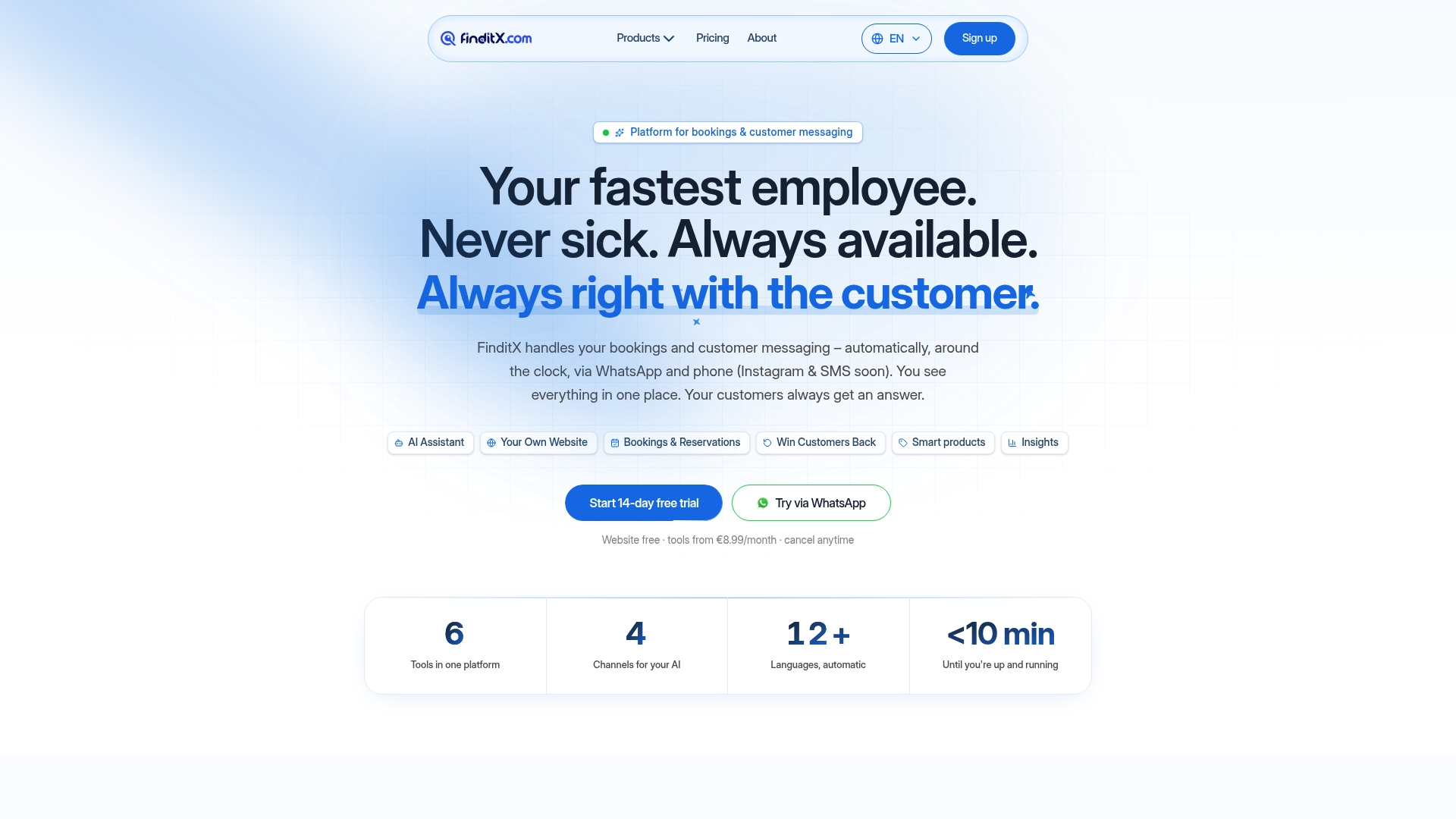
Finditx is built for exactly that gap. Your AI phone assistant answers every call, books appointments without commission, and follows up with patients automatically across phone, WhatsApp, and SMS. No long IT project. No per-seat enterprise pricing. Setup takes under 10 minutes, and your practice starts capturing calls it was previously losing to voicemail the same day. For practices ready to automate patient communication without a multi-week deployment, Finditx’s practice booking platform gives you the core of what an AI receptionist does at a pace that fits how you actually run your clinic.
Key Takeaways
AI medical receptionists that integrate via FHIR R4, sign a BAA before PHI exchange, and use reasoning-based voice agents deliver the most reliable front desk automation for healthcare practices in 2026.
| Point | Details |
|---|---|
| Call resolution rate | Up to 70% of scheduling calls resolve without human involvement, freeing staff for complex tasks. |
| Deployment timeline | Most platforms go live in 2–4 weeks from signed BAA to first patient call. |
| Compliance baseline | Require AES-256 encryption, TLS in transit, PHI excluded from model training, and 7-year audit log retention. |
| Pricing model | Most vendors charge per provider seat and call volume tier, typically replacing 1–3 receptionist roles. |
| Finditx option | Finditx offers AI phone answering and commission-free booking for practices that need fast, lightweight deployment. |
Recommended
Fewer tools. More business.
FinditX is the operating platform for anyone running a business. Presence, AI assistant, and modules — pay only for what you actually use.